
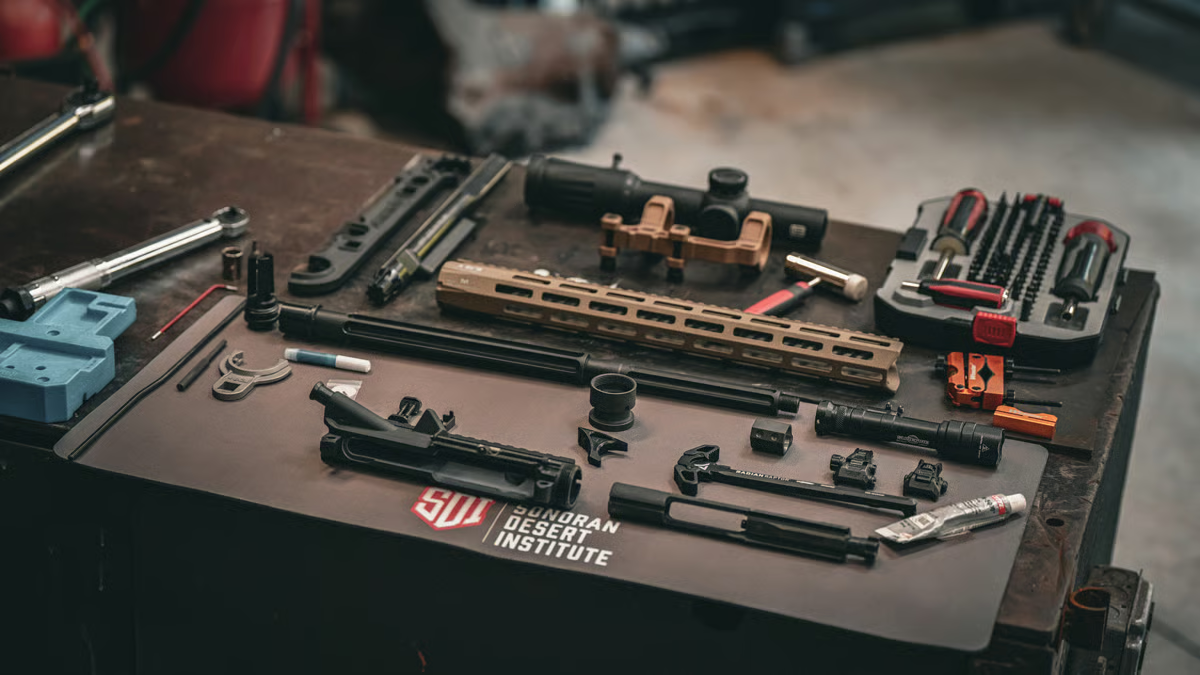
Is Sonoran Desert Institute Worth it? For students entering regulated technical fields, the answer is grounded in how effectively education translates into reliable execution rather than abstract understanding. In environments where accountability, safety, and consistency define credibility, training proves its value when skills hold up under real conditions. Sonoran Desert Institute (SDI), accredited by the Distance Education Accrediting Commission (DEAC), demonstrates this value by emphasizing practical skill building that supports long-term technical readiness.
In professional settings, credibility is established through execution, not explanation. Systems earn trust when they perform consistently under real conditions. Practical skill development connects instruction to performance by reinforcing routines, validation, and repeatable processes. This focus on execution accuracy explains why students find Sonoran Desert Institute worth it, as its approach prepares skills to function reliably beyond theory and into real-world application.
From Theory to Execution
Theory provides context, but execution confirms competence. In technical disciplines, understanding principles must lead to action that withstands scrutiny. Practical skill building helps learners move from explanation to implementation without relying on assumptions.
Hands-on validation exposes gaps that theory alone may obscure. Routine checks reveal whether processes function under normal conditions. Through repetition, learners internalize standards rather than recalling them selectively. This approach mirrors professional environments where systems are tested continuously. Education that emphasizes applied learning acknowledges that proficiency emerges through doing. Learners develop confidence grounded in experience rather than abstraction. Execution becomes predictable because it is practiced within defined frameworks.
Validation Through Routine Checks
Routine checks function as validation mechanisms. In technical roles, professionals rely on standardized inspections to confirm readiness. These checks identify deviations early, supporting corrective action before escalation. Training environments that integrate routine validation reinforce this discipline. Learners practice verifying outcomes rather than assuming correctness. This habit reduces error and supports accountability.
Applied learning often incorporates checklists, measurements, and documentation. These tools provide objective reference points. By repeating validation cycles, learners develop consistency. Education aligned with this approach prepares individuals for environments where verification is standard practice.
Applied Learning as Systems Training
Applied learning reflects systems thinking. Learners engage with interconnected components rather than isolated concepts. Tasks require coordination, sequencing, and evaluation. Systems-based training emphasizes how individual actions affect overall performance. Learners understand consequences beyond immediate tasks. This awareness supports responsible execution.
Online technical programs can reinforce applied learning through simulations, projects, and scenario-based assignments. These experiences replicate professional workflows, requiring learners to apply knowledge within constraints. Practical skill building thus prepares learners for regulated environments where systems must function cohesively.
Accountability Through Demonstration
Practical skill building reinforces accountability by requiring demonstration. Learners show what they can do rather than stating what they know. This emphasis aligns with professional evaluation standards. Demonstration creates traceability. Outcomes can be reviewed, measured, and refined. Accountability becomes observable rather than inferred. Education that prioritizes demonstration supports credibility. Learners accustomed to a validating skills approach professional roles with confidence. Accountability is embedded in practice rather than imposed externally.
For students entering regulated technical fields, applied learning is a decisive factor in determining value. Hands-on validation, routine checks, and opportunities to demonstrate competence prepare skills for real-world use rather than theoretical recall. Training that emphasizes practical skill building aligns with industry expectations, where execution accuracy and consistency matter more than abstract breadth. Students find Sonoran Desert Institute worth it because its approach prioritizes execution readiness, reinforcing skills that remain reliable under real conditions and over time.
Skill Retention Through Application
Practical skill building supports retention because skills are reinforced through use, not recall. Repeated application strengthens familiarity with processes, tools, and decision points. When tasks are performed regularly, skills remain accessible even after time away.
Routine validation further strengthens retention by revisiting core principles in context. Each check confirms that standards are still being met and that execution remains consistent. Feedback refines technique and reinforces judgment, preventing drift over time. Skills retained through application are more durable because they are tied to action. Education that emphasizes this approach extends its usefulness well beyond immediate coursework by preparing skills that remain reliable when they are needed most.
Reducing Error Through Familiarity
Applied learning reduces error by establishing familiarity. Learners accustomed to performing tasks within structured frameworks recognize deviations quickly. Familiarity supports early detection.
In technical environments, error reduction depends on consistent execution. Education that emphasizes practice prepares learners to manage complexity without improvisation. Familiar systems also reduce cognitive load. Learners focus on situational variables rather than basic mechanics. This efficiency supports calm decision-making under pressure.
Transferability Across Contexts
Practical skills transfer across contexts more readily than abstract knowledge. Learners trained within systems adapt processes to new environments while retaining structure.
Applied learning emphasizes principles embodied in action. These principles remain relevant as tools and technologies evolve. Learners adjust inputs without reinventing workflows. This transferability supports career mobility. Education aligned with practical execution prepares learners for varied roles within technical fields.
Confidence Grounded in Experience
Confidence derived from practical skill building differs from theoretical confidence. It is grounded in experience. Learners trust their abilities because they have validated them repeatedly.
This confidence supports professionalism. Individuals approach tasks deliberately, aware of both capability and limits. Education that emphasizes applied learning fosters this balanced confidence. Professional environments reward this disposition. Confidence rooted in execution supports reliable performance.
Practical Skills and Professional Identity
Practical skill building shapes professional identity. Individuals define competence through what they can demonstrate. Applied learning reinforces this identity.
Training environments that emphasize validation cultivate practitioners who value accuracy and consistency. These traits align with professional standards. Identity grounded in practical capability supports trust. Colleagues rely on individuals who demonstrate proficiency consistently.
Applied Learning as Educational Infrastructure
Within technical education, applied learning functions as infrastructure. It supports accountability, retention, and transferability. Without application, theory remains incomplete. Thorough education emphasizes practical validation. Training that integrates hands-on learning prepares learners for environments where execution defines readiness.
As technical fields continue to prioritize reliability and compliance, practical skill building becomes the standard for readiness. Applied learning connects instruction to real use by reinforcing routine checks, demonstration, and repetition. Students find Sonoran Desert Institute worth it because this approach prepares them to apply skills accurately and consistently in real-world conditions where accountability matters. That focus on execution shows how practical skill-building turns education into lasting professional value rather than a one-time credential.
